



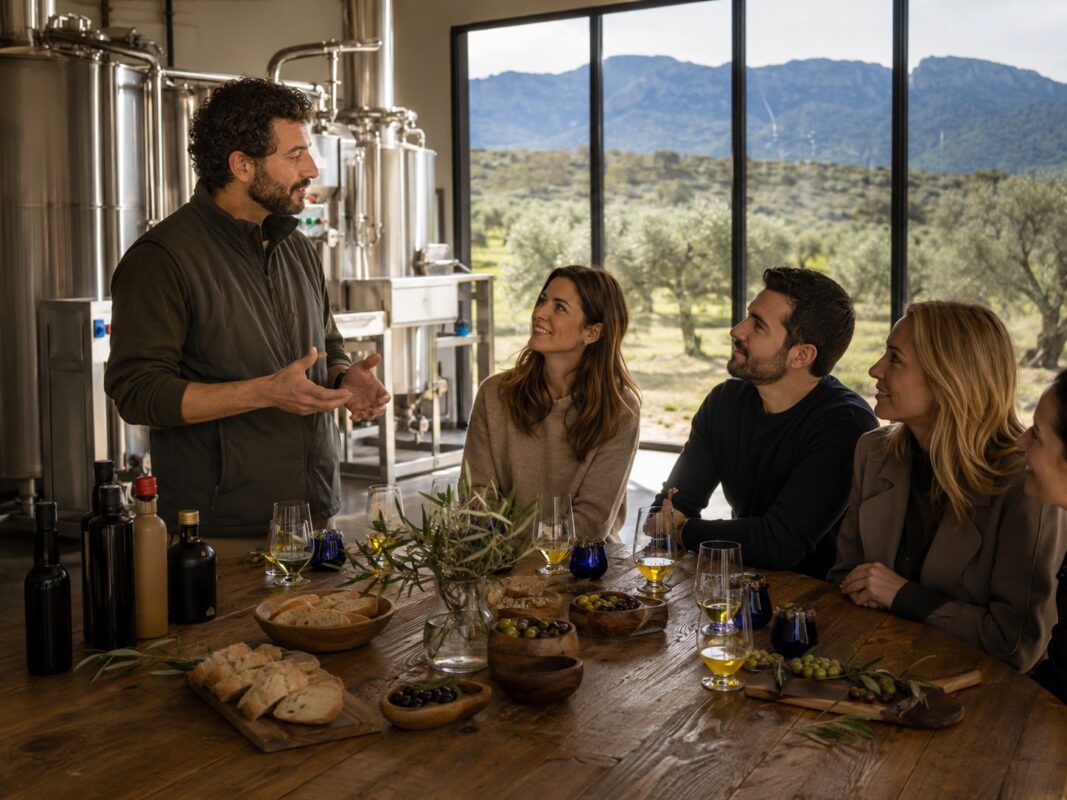
Visiting an olive mill in Mallorca: what to expect from a tour with olive oil tasting
Visiting an olive mill in Mallorca allows you to discover how olives are grown, how olive oil is extracted and how its aromas and flavours can be distinguished during a tasting.
The experience usually combines explanations about the olive grove, a tour of the facilities and a guided tasting. The exact content depends on each estate, the time of year and whether the olive mill is in the middle of the production season.
What is an olive mill?
An olive mill is the facility where olives are transformed into olive oil.
In Mallorca, the Catalan word tafona is also used, especially when referring to traditional facilities or the island’s historic olive oil culture.
Different stages take place in a modern olive mill: reception and cleaning of the olives, crushing, malaxation of the olive paste, extraction, separation, storage and bottling.
During a visit to Son Mesquidassa, the processes are explained from the reception of the olives through crushing, extraction and storage to bottling.
What do you learn during a visit?
The visit helps you understand that olive oil does not begin in the bottle.
Before the olives reach the mill, several factors come into play: the olive variety, the condition of the fruit, the harvesting time, transport and the time elapsed before crushing.
Inside the facilities, visitors learn how the oil is obtained through mechanical procedures and how it is stored until bottling.
The visit also helps explain why two oils can have different profiles even though both are extra virgin olive oils.
Does the visit also include the olive grove?
It depends on the experience booked, the weather and the time of year.
Some visits include an outdoor tour to learn about the trees, the cultivation system and the characteristics of the estate. Others focus on the olive mill and the tasting room.
Son Mesquidassa is located in Felanitx, and its plantation has been described as a vast sea of olive trees. During the visits, both the cultivation methods and the characteristics of the trees and production process are explained.
What happens during the olive harvest?
The harvest season is the period when the olives are collected and brought to the mill for processing.
There is more activity during these days, making it possible to understand the process in a particularly direct way. However, it is also an intense working period, and the conditions of the visits may change.
You should not assume that every machine will be operating during every visit. Production depends on the harvesting calendar, the arrival of the olives and the organisation of each olive mill.
It is advisable to ask which parts of the process will be visible on your chosen date.
What does an olive oil tasting involve?
A tasting allows you to observe the aromas and flavours of different olive oils in a structured way.
First, attention is paid to the aroma. A small amount is then tasted to identify sensations such as fruitiness, bitterness, pungency and persistence.
Bitterness and pungency are not automatically defects. They are among the attributes assessed in virgin olive oils and can appear with varying levels of intensity. European regulations include a specific organoleptic assessment carried out by panels of trained tasters.
Does colour indicate that an olive oil is better?
No.
A very green olive oil may appear more intense, but colour alone is not enough to assess its quality. Coloured glasses are used in professional tastings to prevent visual appearance from influencing the evaluation.
During a visitor experience, it is common to observe the colour because it forms part of the product’s appeal. However, conclusions should be based mainly on aroma and flavour.
What aromas can be detected?
Depending on the olive oil, you may notice aromas reminiscent of:
- Freshly cut grass.
- Olive leaves.
- Tomato.
- Almond.
- Apple.
- Banana.
- Aromatic herbs.
- Ripe fruit.
Not every participant has to identify exactly the same aromas. A tasting is neither an exam nor a competition to see who can find artichoke in a glass before everyone else.
The important thing is to learn how to distinguish different levels of intensity and recognise which profiles each person finds most enjoyable.
Do you need to know about olive oil before attending?
No.
A visit is specifically designed for people who want to learn. The guide explains the process and leads the tasting.
It is helpful to avoid strong perfumes before the tasting, as they can interfere with the perception of aromas. It is also advisable not to smoke, drink coffee or eat strongly flavoured foods immediately beforehand.
How long does a visit last?
The duration depends on the tour, the size of the group and the tastings included.
An experience focused on the olive mill and the tasting may be shorter than one that also includes the olive grove, tours around the estate or a gastronomic tasting.
Before booking, check the expected duration so that you can organise the rest of the day without rushing.
Can you visit an olive mill with children?
Many visits can be interesting for families, particularly when children can see the trees, the olives and the machinery.
However, it is advisable to confirm:
- The recommended minimum age.
- The length of the explanation.
- Accessibility.
- Safety rules.
- Whether the tasting can be adapted.
- Whether there are outdoor areas.
The part focused on agriculture and production may be more appealing to children than an overly technical tasting.
Is it necessary to book?
Booking is recommended.
Olive mills are production centres and do not always operate as tourist attractions with continuous access. Booking allows you to confirm the time, language, number of places and content of the experience.
The current Son Mesquidassa page states that the visit begins with a video about the production process and continues with the tour and olive oil tasting.
What can you buy after the visit?
Many olive mills have a shop or offer direct sales.
After tasting the oils, it is easier to choose one according to its intended use: salads, fish, vegetables, bread, everyday cooking or as a gift.
Son Mesquidassa has an online shop selling olive oils and gastronomic products, as well as direct sales from the estate.
An experience that helps you understand what is inside the bottle
We use olive oil so frequently that it is easy to stop paying attention to it.
Visiting an olive mill gives the product its context back. It allows you to see the trees, understand the agricultural work, follow the production process and discover that aroma, bitterness and pungency do not appear by chance.
Son Mesquidassa offers visits to its estate and olive mill in Felanitx, where visitors can learn about the production process and take part in a tasting of its olive oils.
You can find updated information and request a booking on the page for visits and olive oil tastings at Son Mesquidassa.
Frequently asked questions
What is the difference between an almazara and a tafona?
Almazara is the usual term in Spanish. Tafona is the Catalan word used in Mallorca for the place where olive oil is produced.
Can you visit an olive mill all year round?
Some olive mills organise visits throughout the year, although the content may vary. The machinery only operates when there are olives to process.
When are olives harvested in Mallorca?
The harvest usually takes place mainly in autumn, although the exact dates depend on the variety, ripeness, weather conditions and the decisions of each producer.
Does the tasting include food?
It depends on the experience booked. Some include only olive oil, while others add bread, local products or a broader tasting. This should be confirmed when booking.
Can you buy olive oil at the mill?
Many olive mills offer direct sales. Check the conditions and available formats.
In which language are the visits available?
It depends on each establishment and the date. It is important to specify the required language when making the booking.
Where is Son Mesquidassa located?
Son Mesquidassa is located on Camí de Son Mesquida, in the municipality of Felanitx, Mallorca.