



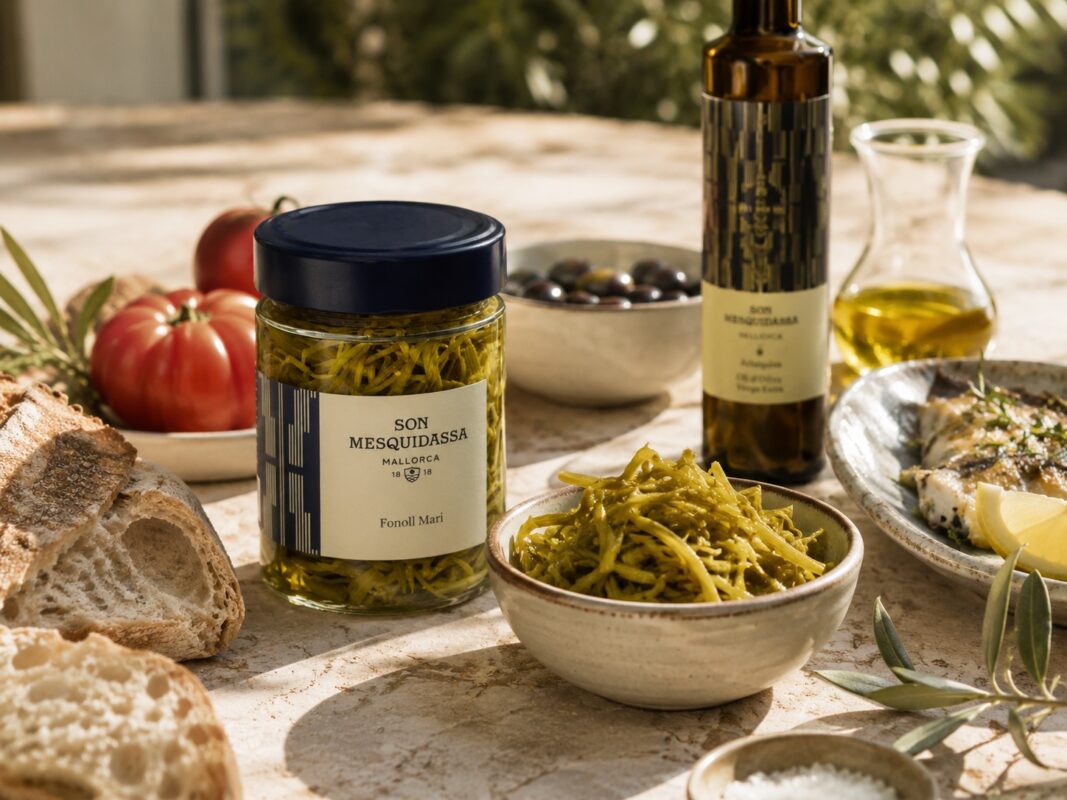
How to eat sea fennel: 7 Mediterranean ideas for enjoying it
Sea fennel can be eaten as an appetiser, added to pa amb oli, used in salads or served alongside fish, cheese and cold dishes. Its aromatic, slightly acidic and salty flavour means it can be used in a similar way to other Mediterranean pickles.
There is no need to prepare a complicated recipe. In fact, it usually works best when added in small amounts, allowing it to provide contrast to the other ingredients.
Sea fennel, whose botanical name is Crithmum maritimum, is an aromatic and edible plant native to coastal areas. In Mallorca, it has traditionally been gathered and preserved in vinegar for consumption.
To learn more about its origin, flavour and connection with the Mallorcan coast, you can read our article about sea fennel and its place in the Mediterranean appetiser.
What does sea fennel taste like?
Sea fennel has an aromatic, vegetal and slightly salty flavour. When preserved in vinegar, it also develops a distinctive acidity that helps refresh rich, salty or intense dishes.
Its leaves are fleshy and retain a certain firmness, so they provide more than flavour. They also add a different texture to salads, appetisers and cold dishes.
It should not be confused with common fennel. Although they share a recognisable aromatic note, sea fennel has a more coastal, acidic and vegetal character. The University of the Balearic Islands describes it as an aromatic coastal plant with succulent leaves that is traditionally preserved in vinegar in Mallorca.
1. On pa amb oli
One of the simplest ways to eat sea fennel is to add it to pa amb oli.
Prepare the bread with tomato, extra virgin olive oil and a pinch of salt. You can then add cheese, ham, preserved fish or a Mallorcan cured meat. Add a small amount of sea fennel at the end to provide acidity and a vegetal note.
It works particularly well when the other ingredients have a certain intensity. It helps balance mature cheeses, cured meats and preserved fish without masking their flavour.
There is no need to cover the entire slice of bread. A few sprigs distributed across the surface are enough.
2. As an accompaniment to fish
Sea fennel pairs well with grilled, baked or steamed fish.
The acidity of the pickle brings freshness to simple preparations. It can be served with sea bream, sea bass, hake, cod or oily fish, particularly when the dish contains only a few ingredients.
An easy way to serve it is to place the fish on the plate, add extra virgin olive oil and finish with a few pieces of sea fennel. You can also chop it and mix it with tomato, onion and parsley to create a fresh garnish.
In this type of dish, it can take the place normally occupied by a slice of lemon, capers or a vinaigrette.
3. In tomato salads
Tomato and sea fennel are a natural combination.
The sweetness and juiciness of the tomato balance the acidity of the pickle. Simply cut several ripe tomatoes, add olive oil, include a few sea fennel leaves and finish with pepper or an aromatic herb.
It can also be combined with onion, fresh cheese, olives or preserved fish.
As sea fennel is already preserved with salt and vinegar, taste the salad before adding more salt or acidity. The Son Mesquidassa jar contains sea fennel, water, salt and wine vinegar.
4. In potato or pulse salads
Potato, chickpea, lentil and bean salads often benefit from an ingredient that contrasts with their softer texture.
Sea fennel can be chopped and mixed into the vinaigrette. This distributes its flavour throughout the salad, allowing it to appear in small notes without dominating the dish.
For example, you can prepare a salad with boiled potatoes, egg, onion, tuna, olive oil and sea fennel. Another option is to combine chickpeas, tomato, cucumber, onion and a few chopped sprigs.
In both cases, it provides a contrast similar to capers, although with a more vegetal and aromatic profile.
5. On a cheese and cured meat board
Pickles help cleanse the palate between intense mouthfuls. This makes sea fennel a good addition to boards of cheese, cured meats and appetisers.
It can be served in a small bowl alongside olives, almonds, bread and olive oil. Each person can take a small amount between different cheeses or combine it directly with the bread.
It works particularly well with mature, semi-mature and goat’s cheeses. It can also accompany ham, sobrasada or spiced cured meats.
Once again, moderation is important. It should not occupy the centre of the board, but act as a counterpoint.
6. Chopped into sauces and dressings
Sea fennel can also be used as an ingredient in a cold sauce.
Chop it finely and mix it with extra virgin olive oil, tomato, onion, parsley or fresh herbs. This preparation can be served over fish, potatoes, roasted vegetables or toasted bread.
Another option is to add it to homemade mayonnaise, a yoghurt sauce or a vinaigrette. In these cases, add it gradually and taste the mixture before including more vinegar or salt.
It can also be lightly blended, but there is no need to turn it into a completely smooth cream. Keeping a few small pieces preserves some of its texture.
7. As a simple appetiser
The most direct way to eat sea fennel is to serve it on its own, well drained, as part of an appetiser.
It can be accompanied by bread, olive oil, olives, almonds and cheese. It requires no additional preparation.
This presentation makes it easier to recognise its flavour before using it in other dishes. It also allows each person to decide which ingredient they would like to combine it with.
In Mallorca, preserving it in vinegar forms part of its traditional culinary use. It is not simply a modern ingredient recovered by fine dining, but a way of preserving and enjoying a flavour connected to the coast.
Should sea fennel be drained before serving?
Yes. The usual approach is to remove the required amount from the jar and allow the excess liquid to drain before adding it to the dish.
There is no need to rinse it. Doing so removes some of its flavour and the acidity of the pickle. Rinsing may be useful when a milder result is preferred, but draining it is normally sufficient.
Always use clean cutlery to remove the product from the jar and follow the storage instructions shown on the packaging.
How much should you use?
Sea fennel is used as a condiment or accompaniment rather than as the main ingredient.
A few sprigs may be enough for toast or pa amb oli. For a salad shared by several people, add a small amount of chopped sea fennel, taste it and adjust afterwards.
It is easier to add a little more than to correct a dish in which the vinegar or salty flavour has become too prominent.
Sea fennel, olives or capers: which should you choose?
The choice depends on the dish and the effect you want to achieve.
Olives have more volume, a fleshy texture and a recognisable flavour. Capers provide small bursts of acidity and saltiness. Sea fennel also adds its own distinctive vegetal and aromatic note.
They are not completely interchangeable ingredients. Each one can alter the balance of a recipe.
In our guide to choosing between sea fennel, capers and olives, we explain what each pickle contributes and which dishes it generally works best with.
A small ingredient that changes the dish
Sea fennel does not need to become the main ingredient to make its presence felt.
A few sprigs can add contrast to fish, refresh a salad, balance an intense cheese or complete pa amb oli. This is precisely one of its attractions: it can transform simple preparations without adding complicated processes.
At Son Mesquidassa, we present it pickled with water, salt and wine vinegar, ready to drain and serve. You can discover Son Mesquidassa Sea Fennel 350 g and begin with the simplest combination: good bread, tomato, olive oil and a few sprigs of sea fennel.
Frequently asked questions
Can sea fennel be eaten raw?
It can be eaten fresh, cooked or preserved. In Mallorca, it is traditionally found pickled in vinegar and ready to serve as an appetiser or accompaniment.
Which foods does it pair best with?
It pairs particularly well with tomato, fish, potatoes, pulses, cheese, cured meats, preserved foods and bread with olive oil.
Does pickled sea fennel need to be cooked?
No. Pickled sea fennel can be eaten directly after draining it. When adding it to a hot dish, it is preferable to include it at the end to preserve its texture and acidity.
Can it be added to a salad?
Yes. It can be added whole or chopped. Taste the salad before adding more salt or vinegar, as the pickle already provides both flavours.
Is sea fennel the same as common fennel?
No. They are different plants. Sea fennel is Crithmum maritimum, an edible species associated with coastal areas.
How should it be served as an appetiser?
It can be drained and served in a small bowl alongside olives, bread, olive oil, cheese, almonds or cured meats.