



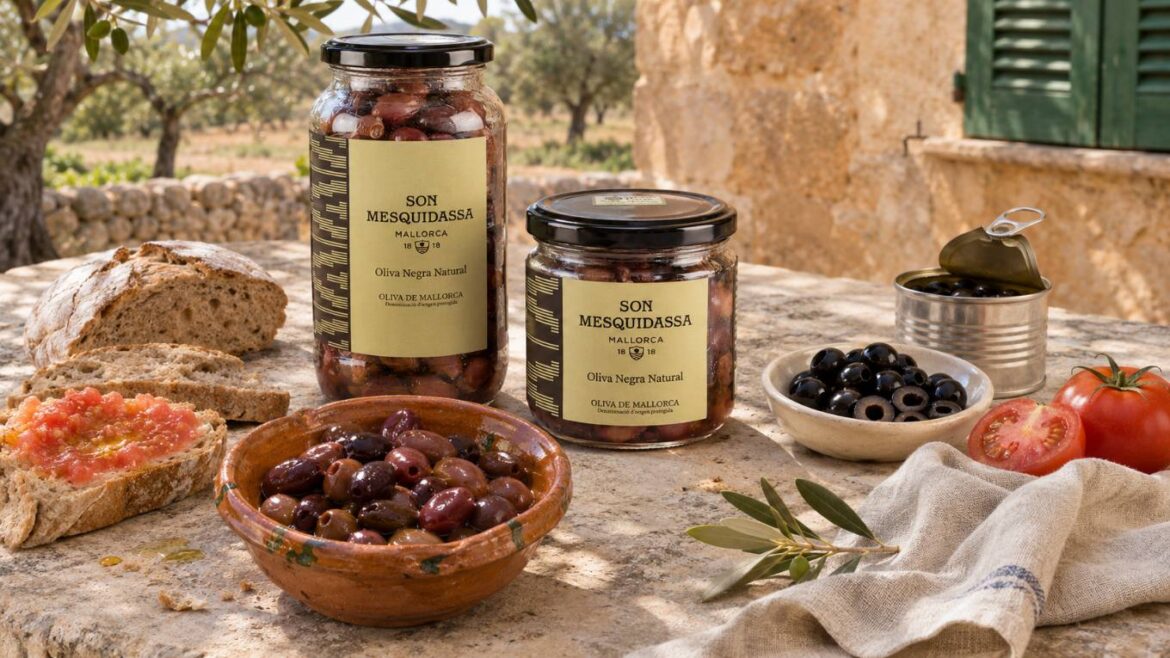
You pick up two packs of black olives at the supermarket. One contains ferrous gluconate; the other does not.
They look alike.
But natural black olives and the familiar canned black olives can reach that colour in different ways.
Natural black olives are harvested ripe or almost ripe, when they are already dark. Olives darkened by oxidation are picked earlier and turn dark during processing.
One thing, though.
Natural black olives can also come in a can. This is not a difference in packaging. It is a difference in ripening and processing.
At Son Mesquidassa, we offer natural black olives from Mallorca. But each preparation has its uses. Here is what to look for when choosing yours.
- A quick comparison
- Ripening and processing
- How to recognise them on the label
- Flavour, uses and price
- Frequently asked questions
- The Son Mesquidassa option
Natural black olives vs canned black olives: a quick comparison
In this table, “canned” refers to the familiar black olives darkened by oxidation, rather than every olive sold in a can.
| What you are comparing | Natural black olives | Olives darkened by oxidation |
|---|---|---|
| Harvest time | Fully ripe or shortly before full ripeness. | Green or changing colour, before fully ripening. |
| Where the colour comes from | The fruit ripening on the olive tree. | Oxidation during processing. |
| Appearance | Purple, brown, reddish or black shades, depending on the fruit. | Brown to black, usually with a very uniform colour. |
| Preparation | Processing is needed to reduce bitterness; brining is one option. | Typically, alkaline treatment, washing, aeration and sterilisation. |
| Colour stabilisers | The colour develops through ripening; check each product’s ingredients. | May contain ferrous gluconate or ferrous lactate. |
| Why choose them | To explore a particular variety and preparation, especially as an appetiser. | For recipes where you want a uniform result and ready-sliced options. |
The first difference starts on the tree
Natural black olives: the fruit is already dark
Olives change colour as they ripen. If left on the tree, they develop the shades associated with their maturity.
Purple. Brown. Black.
The Spanish quality standard for table olives distinguishes natural black olives, harvested ripe or almost ripe, from olives darkened by oxidation.
That is why natural black olives can have different shades. They do not have to be wrinkled either: their appearance depends on the variety and preparation.
Does natural mean eaten straight from the tree?
No.
They also need processing to reduce their bitterness and preserve them. Brine, a mixture of water and salt, is one common preparation.
Olives darkened by oxidation: the colour develops later
These start as green olives or olives beginning to change colour. The usual process combines alkaline treatment to reduce bitterness, washing and aeration.
When exposed to oxygen, compounds in the fruit oxidise and darken.
Iron salts may then be added to stabilise that colour. The International Olive Council explains this process, which includes sterilising the canned product.
They are real olives.
Calling them “fake olives” is misleading. What differs is how they become black.
How to tell whether black olives are naturally ripe
Turn the pack over.
The product name and ingredients tell you more than the shade of black in the photograph.
- Look for the description “natural black olives”. Check the information about ripening and processing too.
- Check for ferrous gluconate, E-579, ferrous lactate or E-585. These are stabilisers used in olives darkened by oxidation.
- Look at the variety and origin. “Black olives” alone tells you little about the fruit you are going to eat.
- If the description is unclear, ask the producer. The absence of these additives does not, by itself, prove how the colour was obtained.
What ferrous gluconate and ferrous lactate do
They help maintain the dark colour achieved during oxidation. Their role is to stabilise it, rather than replace the fruit’s ripening process.
Their use is regulated. Finding them on the label does not make a pack of olives harmful.
Choosing a recipe without these stabilisers is a valid preference too. It helps to distinguish a preference from a cause for alarm.
Flavour, uses and price: which olives suit your table?
For appetisers and pa amb oli
Here, we would choose natural black olives of a known variety and origin. Served on their own, their flesh, seasoning and bitterness are easier to appreciate.
Bread is enough.
For natural black olives covered by the Oliva de Mallorca PDO, the specification describes soft, juicy, unctuous flesh with a slight bitterness.
A combination that invites you to try them with tomato and Joan Rosselló extra virgin olive oil.
Taste everything together before adding salt. If you finish the dish with our fleur de sel from Mallorca, start with a small pinch and taste again.
For pizzas, pasta and quick recipes
If you buy sliced black olives to scatter over a pizza, convenience matters. That format saves you the work of pitting and slicing.
It has its place.
You can cook with natural black olives too. Remove the stones, chop the flesh and try adding it to tomato pasta or a slice of toast.
Intensity depends on the variety, brine and seasoning. “Natural” and “darkened by oxidation” cannot tell you everything about the flavour.
How to compare prices fairly
Check the drained weight when olives are packed in liquid. The total weight of a preserve may include water you will not be eating.
Then compare like with like: whole or pitted, variety, origin and preparation. The price per jar does not tell the whole story.
Think about how much you will eat too. The larger jar is practical for sharing; the smaller one may suit occasional servings better.
Frequently asked questions about black olives
Are all canned black olives darkened by oxidation?
No.
A can is a container. To understand the product, check its name, ingredients and the producer’s information.
Are natural black olives always wrinkled?
Not necessarily.
Drying and preparation affect the skin. Wrinkles, shine or colour cannot identify them with certainty.
Are natural black olives always healthier?
Not by definition.
The origin of the colour does not determine the nutritional profile on its own. Compare each product’s information, including its salt content.
Can I recognise oxidation-darkened olives by the code E-579?
It is a clue.
It identifies ferrous gluconate, a colour-retention agent. The label may use its full name instead, or list ferrous lactate, E-585.
Son Mesquidassa natural black olives: your next appetiser
If you are looking for olives that developed their colour while ripening on the tree, this is our offering.
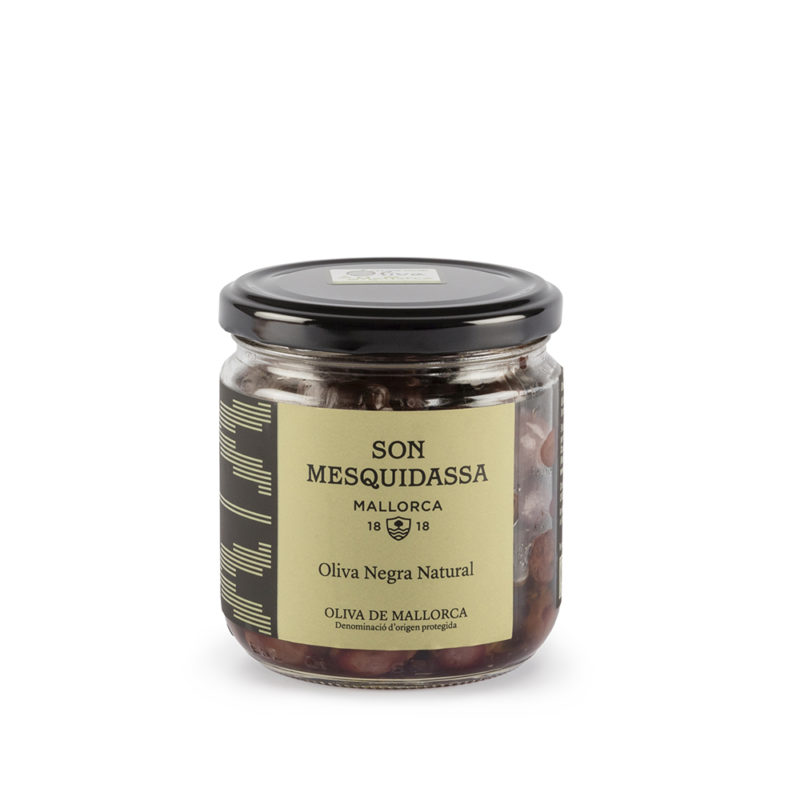
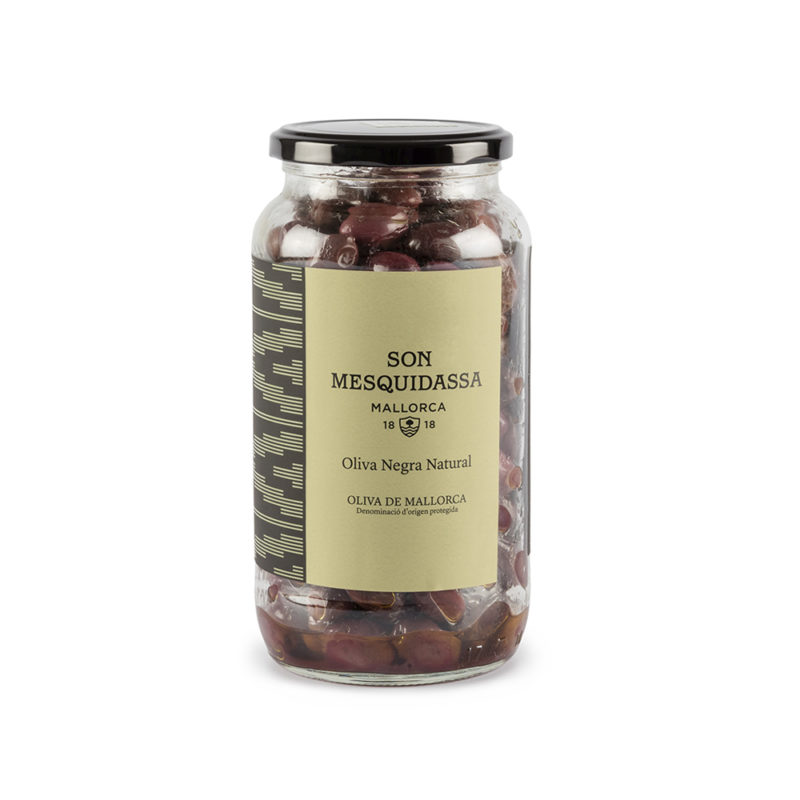
Natural black olives of the Mallorquina variety, from Felanitx. Our product pages list three ingredients: natural black olives, water and salt.
| Size | When it might suit you | Product details |
|---|---|---|
| 330 g | For trying them or serving them as an occasional appetiser. | Natural black olives 330 g |
| 1,000 g | For sharing, or if olives have a regular place at your table. | Natural black olives 1,000 g |
Each product page shows the price and availability. You will also find other accompaniments in the Son Mesquidassa shop.
To start with, a small plate, bread and tomato. Plenty of room for the olives to make themselves known.