



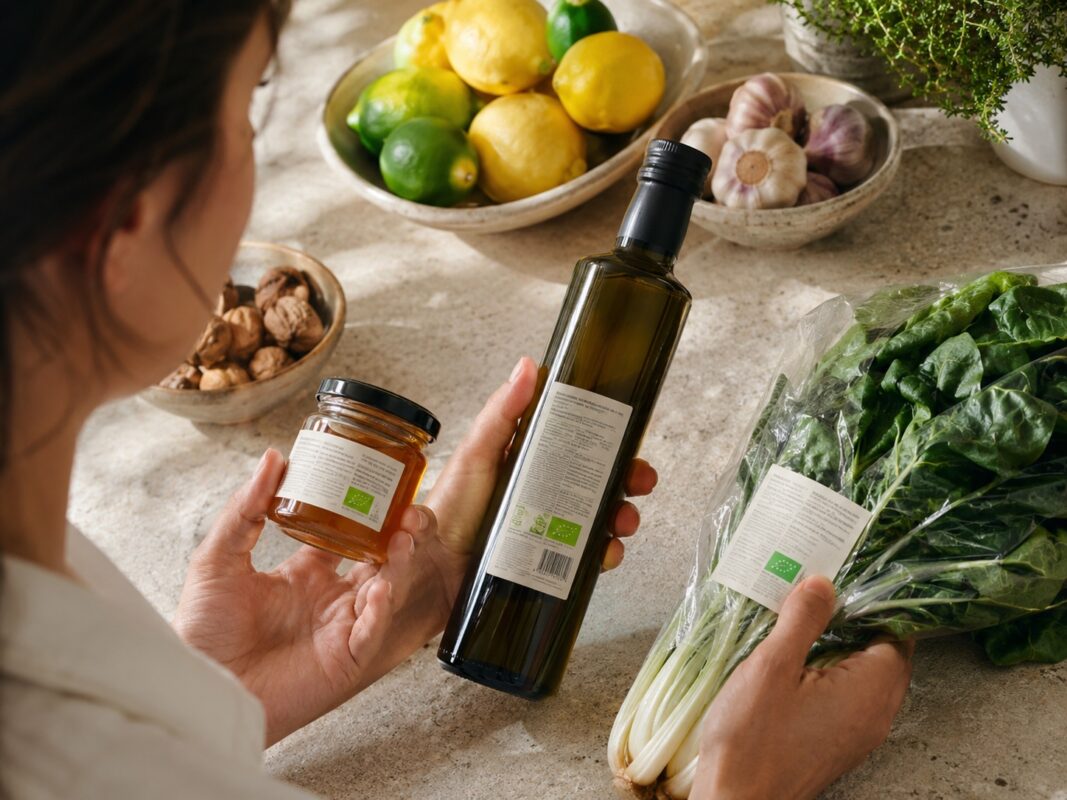
What it really means for food to be organic: labels, origin and practices
Organic food is food that has been produced, processed, transported and stored in accordance with European organic production regulations and certified by an authorised control body.
It is not enough for the packaging to be green, feature drawings of leaves or use words such as “natural”, “from the land” or “environmentally friendly”. For food to be marketed as organic, it must be subject to a certification and control system.
What does the European organic logo guarantee?
The European Union organic logo identifies products that comply with the applicable rules on organic production, processing, transport and storage.
For processed foods, the logo may be used when at least 95% of the agricultural ingredients are organic and the remaining percentage also complies with specific conditions.
The symbol is a leaf made up of white stars on a green background. Its presence makes it easy to identify a certified product, but it should not be the only information you check.
The following information must appear beside the logo:
- The code of the control body or authority.
- An indication of where the agricultural raw materials were produced.
- References such as “EU Agriculture”, “Non-EU Agriculture” or a more specific geographical indication where appropriate.
Who controls organic products in the Balearic Islands?
In the Balearic Islands, the Consell Balear de la Producció Agrària Ecològica, or CBPAE, is the organisation responsible for certifying and controlling organic agricultural and food products within the autonomous community.
The CBPAE maintains registers of operators, carries out control functions and works to promote organic agricultural production.
An organic label is therefore not a voluntary declaration of good intentions. It is linked to procedures, registers and controls.
Does organic mean that no products are used?
Not exactly.
Organic production considerably restricts the use of synthetic products and prioritises natural substances and processes. However, this does not mean that farmers simply stare intensely at their crops until the pests disappear.
Certain products and practices are authorised under organic regulations. The difference lies in which substances may be used, under what circumstances and subject to which control conditions. Among other objectives, organic agriculture seeks the responsible use of resources, the conservation of biodiversity, soil fertility and the preservation of water quality.
Do organic and natural mean the same thing?
No.
“Organic” is a regulated designation within agricultural and food production. “Natural” is a much broader word and, outside specific contexts, does not prove that the product has undergone an equivalent organic certification system.
A food product may use recognisable ingredients or be minimally processed and be presented as natural without being organic.
That is why it is important to separate the impression created by the packaging from the information it actually certifies.
Does organic mean local?
No.
A product may be certified as organic and have been produced thousands of kilometres away. Likewise, food grown nearby may not belong to the organic production system.
The label refers to the certified production method. The origin should be checked on the label itself and through information provided by the producer.
For many consumers, the ideal product may be organic, locally produced and have a clearly identified origin. However, these are three different criteria.
Are local and zero-mile products the same thing?
There is no single universal distance that automatically turns a product into a “zero-mile” product.
The concept is generally used to highlight the proximity between production and consumption, but it is advisable to look for specific information:
- Place of cultivation or production.
- Distance to the point of sale.
- Identity of the producer.
- Number of intermediaries.
- Seasonality.
- Traceability.
The term “local product” is more useful when accompanied by a recognisable place rather than only a photograph of a field at sunrise.
What does it mean for food to be sustainable?
“Sustainable” is a broader concept than “organic”.
It may refer to the management of soil, energy, water, waste, biodiversity, social conditions, economic viability or the long-term continuity of a production system.
European agricultural policy distinguishes three dimensions of agricultural sustainability: economic, environmental and social.
When assessing a sustainability claim, it is therefore advisable to ask:
- Which specific practice is being applied?
- Is there an indicator or measurable figure?
- Which resource is being reduced or recovered?
- How is waste managed?
- What happens with water and energy?
- Is there independent certification?
- Does the producer also report the areas that still need improvement?
Sustainability is easier to understand through actions and results than through adjectives.
Does artisan mean organic?
No.
“Artisan” usually describes a method of production, a production scale or the direct involvement of people in the process. It does not necessarily mean that the raw materials are organic.
A product may be:
- Artisan and organic.
- Artisan and non-organic.
- Industrial and organic.
- Local, but not organic.
- Organic, but not local.
These categories can be combined, but none automatically replaces the others.
How should you read an organic label?
Start by locating the European organic logo and the code of the control body.
Then check:
- The actual name of the food.
- The country or place of production.
- The list of ingredients.
- The percentage of organic ingredients, where applicable.
- The identity of the producer or processor.
- The storage conditions.
- Additional information about origin and certification.
In the Balearic Islands, you can also check which operators appear in the CBPAE organic directory.
Is an organic product automatically more sustainable?
Not always and not in every respect.
Organic certification confirms compliance with a set of production rules. However, the total impact also depends on packaging, transport, energy consumption, water management, storage, waste and the scale of the system.
The label is an important and verifiable sign. It is not a magic layer that solves every possible impact by itself.
From the label to the way food is produced
Reading a label tells you what has been certified. Understanding the process allows you to see how that certification translates into specific decisions.
At the next level, we examine how a sustainable olive grove works and the role played by soil, water, biodiversity and the reuse of materials.
You can also discover the actions included by Son Mesquidassa in its project A Sea of Sustainability, which explains various measures applied on the estate and in the olive mill.
Frequently asked questions
What is the difference between organic and biological?
Under European regulations, terms such as organic, biological and their abbreviations are used to identify products subject to the regulated organic production system.
Can organic food contain pesticides?
Organic production restricts the use of synthetic pesticides and permits only certain substances and methods under regulated conditions. Organic does not mean the complete absence of any agricultural intervention.
How do I know whether an organic label is official?
Look for the European leaf made up of stars, the code of the control body and the indication of the origin of the agricultural raw materials.
Is a local product always more sustainable?
Proximity may reduce some transport, but overall sustainability also depends on cultivation, energy, water, packaging, transport and waste management.
What does the CBPAE do?
It certifies and controls organic agricultural and food products in the Balearic Islands and maintains registers of authorised operators.